

Buy Epithalon Peptide Ireland
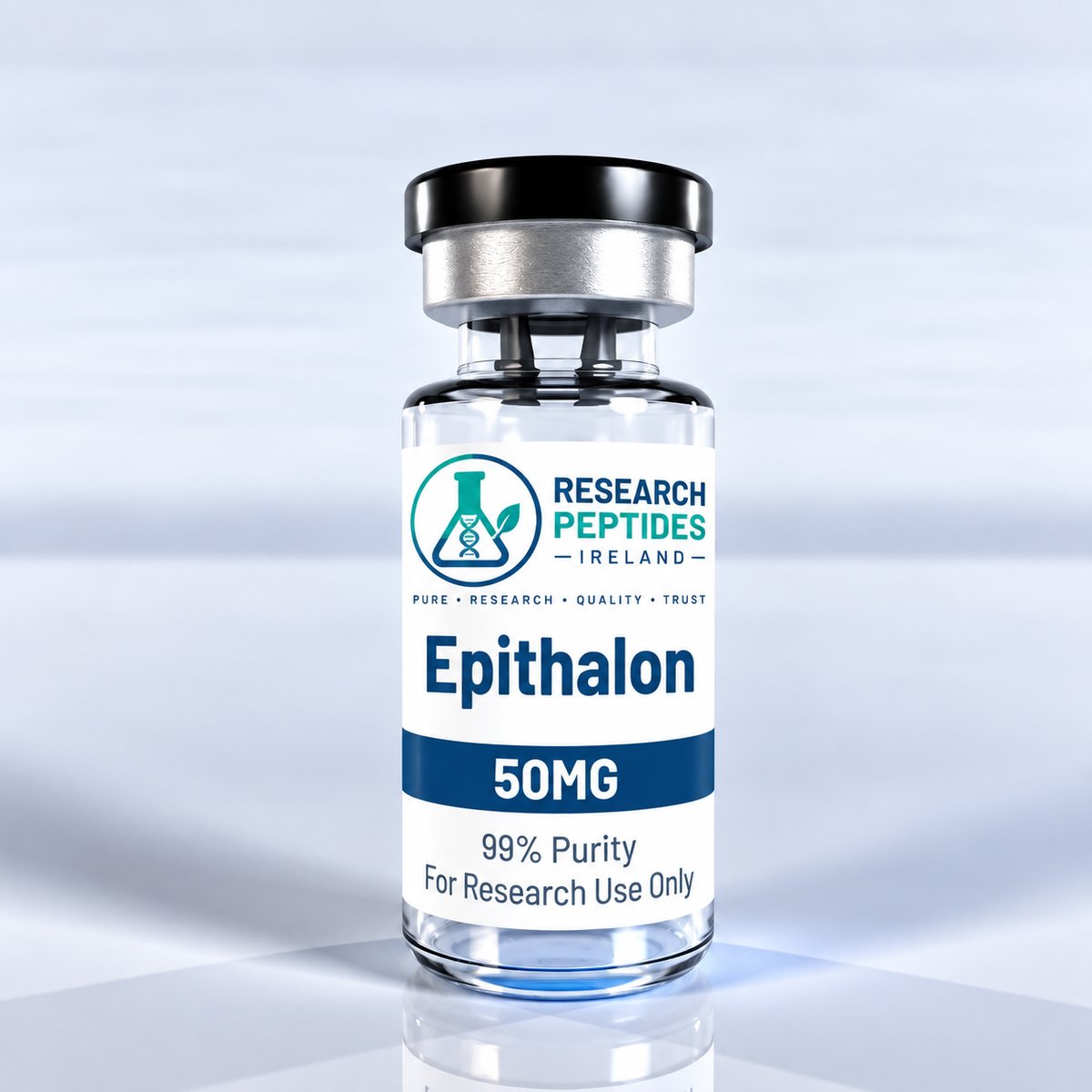
Buy Epithalon Peptide in Ireland in 10ng and 50mg formats for laboratory and scientific research. Epithalon, also written as Epitalon or Epithalone, is a synthetic tetrapeptide with the sequence Ala-Glu-Asp-Gly (AEDG). It has been studied in peptide research and experimental research involving cellular ageing, telomere biology, pineal-related biology and molecular signalling. PubChem lists Epitalon with the molecular formula C14H22N4O9 and molecular weight of approximately 390.35 g/mol.
What Is Epithalon Peptide?
Epithalon, commonly spelled Epitalon, is a synthetic four-amino-acid peptide. Its sequence is:
Ala-Glu-Asp-Gly (AEDG)
Because it contains four amino acids, Epithalon is classified as a tetrapeptide.
The compound is associated with research into biological ageing and pineal-related molecular processes. Research literature and scientific databases identify Epitalon as a defined peptide compound rather than a complex mixture. PubChem identifies the sequence as AEDG and lists Epitalon under several names, including Epithalon, Epithalone and Ala-Glu-Asp-Gly.
Epithalon Peptide 10ng & 50mg
Research Peptides Ireland offers Epithalon in two product quantities:
- Epithalon Peptide 10ng
- Epithalon Peptide 50mg
These are very different quantities, so researchers should select the format that matches their laboratory requirements.
| Product | Quantity | Peptide |
|---|---|---|
| Epithalon Peptide | 10ng | Epithalon |
| Epithalon Peptide | 50mg | Epithalon |
The 10ng format is an extremely small quantity, while the 50mg format provides a substantially larger amount of research material.
Epithalon Peptide Specifications
| Specification | Details |
|---|---|
| Product name | Epithalon Peptide |
| Alternative names | Epitalon, Epithalone |
| Peptide type | Synthetic tetrapeptide |
| Sequence | Ala-Glu-Asp-Gly (AEDG) |
| Amino acids | 4 |
| Molecular formula | C14H22N4O9 |
| Molecular weight | 390.35 g/mol |
| CAS identifiers | 64082-79-7; 307297-39-8 |
| Available quantities | 10ng and 50mg |
| Product category | Research peptide |
| Intended use | Laboratory research only |
PubChem lists Epitalon with the molecular formula C14H22N4O9, molecular weight 390.35 g/mol, and sequence AEDG. It also lists 64082-79-7 and 307297-39-8 among its identifiers.
Epithalon Peptide Sequence
The molecular sequence of Epithalon is:
AEDG
In full:
Ala-Glu-Asp-Gly
This means that the peptide contains:
- Alanine (Ala)
- Glutamic acid (Glu)
- Aspartic acid (Asp)
- Glycine (Gly)
The short four-amino-acid structure makes Epithalon considerably smaller than many commonly researched peptide compounds.
Understanding the sequence is important for laboratory work involving peptide identification, synthesis, analytical testing and structure-function research.
Epithalon and Cellular Ageing Research
Epithalon has attracted scientific interest primarily because of research surrounding cellular ageing and biological processes associated with the pineal gland.
Research involving Epithalon has examined areas such as:
- Cellular ageing
- Telomere biology
- Telomerase-related research
- Pineal-related molecular biology
- Peptide signalling
- Gene-expression research
- Cellular stress research
- Oxidative-stress models
- Longevity-related laboratory research
These areas represent research subjects rather than established therapeutic applications.
Epithalon is particularly interesting to researchers because its small, well-defined structure makes it suitable for controlled peptide research and molecular investigation.
Epithalon and Telomere Research
One of the most frequently discussed areas of Epithalon research is telomere biology.
Telomeres are protective DNA-protein structures found at the ends of chromosomes. Researchers study telomeres because their length and maintenance are associated with cellular replication and ageing-related biology.
Some experimental research involving Epithalon has investigated potential relationships between the peptide and telomerase activity.
Telomerase is an enzyme involved in maintaining telomere length in certain cells.
This makes Epithalon relevant to laboratory research examining:
- Telomerase activity
- Telomere maintenance
- Cellular replication
- Cellular ageing models
- Molecular mechanisms associated with ageing
These findings should be understood within the context of experimental research and should not be interpreted as evidence that Epithalon is an established treatment for ageing or age-related conditions.
Epithalon and Pineal Research
Epithalon is historically associated with research into epithalamin, a preparation derived from pineal tissue.
Epithalon was developed as a defined tetrapeptide corresponding to the sequence Ala-Glu-Asp-Gly. Research descriptions commonly connect the peptide with work originating from studies of pineal-related biology.
For modern laboratory research, the advantage of a defined synthetic peptide is that researchers can work with a specific molecular structure rather than a complex biological extract.
Epithalon 10ng
The 10ng Epithalon format provides a very small quantity of the peptide.
A nanogram is one-billionth of a gram:
1 ng = 0.000000001 g
The 10ng format may therefore be relevant to research applications where only a very small quantity of peptide material is required.
Researchers should carefully distinguish 10ng from 10mg, as the two quantities differ by a factor of one million.
Epithalon 50mg
The 50mg Epithalon format provides a significantly larger quantity for laboratory research.
A 50mg format may be suitable for research programmes requiring a greater amount of peptide material for analytical or experimental work.
The 50mg product contains the same Epithalon molecule:
Ala-Glu-Asp-Gly (AEDG)
with a total supplied quantity of 50mg.
10ng vs 50mg Epithalon
| Feature | Epithalon 10ng | Epithalon 50mg |
|---|---|---|
| Quantity | 10ng | 50mg |
| Peptide | Epithalon | Epithalon |
| Sequence | AEDG | AEDG |
| Molecular weight | 390.35 g/mol | 390.35 g/mol |
| Product type | Research peptide | Research peptide |
| Intended use | Laboratory research | Laboratory research |
The main difference between the two products is the quantity supplied. The underlying peptide is the same.
Epithalon vs Epithalon Derivatives
Researchers should distinguish standard Epithalon from chemically modified forms.
Standard Epithalon has the molecular formula:
C14H22N4O9
and molecular weight:
390.35 g/mol.
For example, Epithalon TFA is a trifluoroacetate form with a different molecular formula and molecular weight. PubChem lists Epithalon TFA at approximately 504.37 g/mol.
Similarly, N-acetyl Epitalon has a different chemical structure and molecular formula from standard Epithalon.
For research ordering and analytical work, it is therefore important to identify the exact molecular form being studied.
Epithalon Peptide for Laboratory Research
Epithalon can be used as a defined research material in laboratory investigations involving peptide chemistry and cellular biology.
Potential research areas include:
Peptide chemistry
Researchers can investigate synthesis, molecular structure, purity and analytical characteristics.
Cellular ageing
Epithalon has been investigated in experimental models involving cellular ageing and related biological processes.
Telomere research
Researchers can study molecular pathways associated with telomere maintenance and telomerase activity.
Molecular biology
The peptide can be investigated in controlled experimental systems examining cellular and molecular signalling.
Comparative peptide research
Epithalon can also be compared with other short peptides and peptide derivatives to investigate differences in molecular characteristics.
Epithalon Quality Testing
Quality documentation is an important part of research peptide selection.
Available product documentation may include:
- Product identity
- Batch or lot number
- Quantity
- Purity
- HPLC analysis
- Mass spectrometry
- Testing date
- Product specifications
HPLC Testing
High-performance liquid chromatography can be used to examine peptide purity and chromatographic characteristics.
Mass Spectrometry
Mass spectrometry can help researchers examine molecular mass and support compound identification.
For a small peptide such as Epithalon, analytical characterization is particularly useful when researchers need to distinguish the standard AEDG peptide from modified forms.
Storage and Handling
Epithalon should be stored and handled according to the product documentation and established laboratory procedures.
Researchers should consider:
- Appropriate temperature conditions
- Protection from moisture
- Protection from direct light
- Keeping the container properly sealed
- Minimizing unnecessary exposure to environmental conditions
- Following appropriate laboratory handling procedures
Specific storage requirements should be based on the product documentation supplied with the research material.
Why Buy Epithalon Peptide in Ireland?
Buying Epithalon Peptide from an Ireland-focused research supplier provides convenient access to a defined synthetic peptide in two quantity options.
Research Peptides Ireland offers:
- 10ng Epithalon
- 50mg Epithalon
- Product specifications
- Research information
- Quality information
- Laboratory-use classification
- Ireland delivery options
The product is suitable for researchers looking for a defined AEDG tetrapeptide for scientific and laboratory research.
Epithalon Peptide Ireland Delivery
Epithalon Peptide is available for customers in Ireland, subject to applicable laws and regulations.
Worldwide delivery may also be available where permitted by the destination country’s regulations concerning research peptides and laboratory materials.
Customers should ensure that research materials are permitted for their intended laboratory use and destination.
Buy Epithalon Peptide 10ng & 50mg Ireland
If you are looking to buy Epithalon Peptide in Ireland, Research Peptides Ireland offers the peptide in 10ng and 50mg formats.
Epithalon is a defined synthetic tetrapeptide with the sequence Ala-Glu-Asp-Gly (AEDG) and molecular weight of approximately 390.35 g/mol.
Researchers can choose the quantity that best fits their laboratory requirements.
Epithalon Peptide 10ng & 50mg — research-grade AEDG tetrapeptide for laboratory research.
Research Use Only
Epithalon Peptide is supplied strictly for laboratory and scientific research.
It is not marketed as a medicine, dietary supplement or consumer health product.
This product page does not provide instructions for human administration, dosing or treatment.
Frequently Asked Questions
What is Epithalon Peptide?
Epithalon, also known as Epitalon or Epithalone, is a synthetic tetrapeptide with the sequence Ala-Glu-Asp-Gly (AEDG).
What is the Epithalon peptide sequence?
The sequence is AEDG, representing Ala-Glu-Asp-Gly.
How many amino acids are in Epithalon?
Epithalon contains four amino acids, making it a tetrapeptide.
What is the molecular weight of Epithalon?
The molecular weight of Epithalon is approximately 390.35 g/mol.
What is the molecular formula of Epithalon?
The molecular formula is C14H22N4O9.
What sizes of Epithalon are available?
This product is available in 10ng and 50mg formats.
What is the difference between 10ng and 50mg?
The difference is the amount supplied. 10ng is an extremely small quantity, while 50mg is a substantially larger research format.
What is Epithalon studied for?
Epithalon has been investigated in research involving cellular ageing, telomere biology, telomerase-related research, pineal-related biology and peptide chemistry.
Is Epithalon the same as Epitalon?
Yes. Epithalon and Epitalon are commonly used names for the same AEDG tetrapeptide. PubChem lists both names as synonyms.
Is Epithalon the same as Epithalon TFA?
No. Epithalon TFA is a different chemical form containing trifluoroacetate and has different molecular characteristics.
Does Epithalon have a CAS number?
Yes. PubChem lists 64082-79-7 and 307297-39-8 among identifiers associated with Epitalon.
Is Epithalon available in Ireland?
Yes. Epithalon Peptide is available in 10ng and 50mg research formats for customers in Ireland, subject to applicable regulations.
Is Epithalon for human use?
No. Epithalon is supplied strictly for laboratory research use and is not intended for human use or self-administration.






There are no reviews yet.