
Buy NAD+ 500mg Ireland
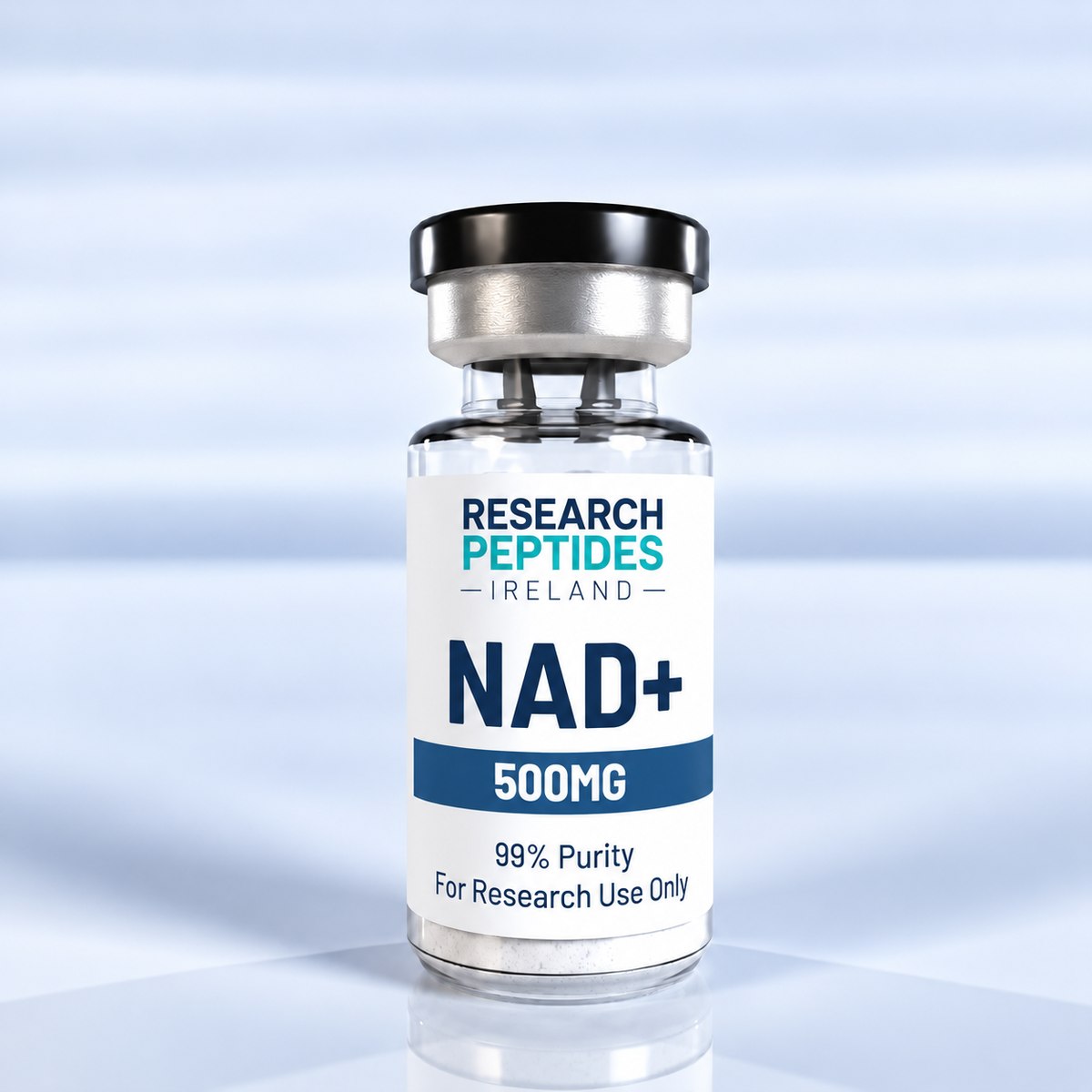
Buy NAD+ 500mg in Ireland as a research-grade biochemical compound for laboratory and scientific research. NAD+, or nicotinamide adenine dinucleotide, is a naturally occurring cellular coenzyme involved in oxidation-reduction reactions and numerous enzyme systems. It is studied in research involving cellular metabolism, redox biology, mitochondrial function, energy-transfer pathways, DNA-related processes and cellular signalling.
What Is NAD+?
NAD+ stands for nicotinamide adenine dinucleotide. It is a dinucleotide coenzyme found in living cells and plays an important role in biochemical electron-transfer reactions.
NAD+ exists primarily in its oxidized form and can be converted to NADH during reduction reactions. This reversible NAD+/NADH system is an important part of cellular redox biology and metabolic research.
NAD+ is not a peptide. It is a small-molecule dinucleotide composed of two nucleotide units joined through phosphate groups.
NAD+ 500mg Product Details
| Specification | Details |
|---|---|
| Product Name | NAD+ |
| Full Name | Nicotinamide Adenine Dinucleotide |
| Alternative Names | β-NAD, NAD, Diphosphopyridine Nucleotide |
| Quantity | 500mg |
| Compound Type | Dinucleotide coenzyme |
| Molecular Formula | C₂₁H₂₇N₇O₁₄P₂ |
| Molecular Weight | 663.43 g/mol |
| CAS Number | 53-84-9 |
| PubChem CID | 15938971 |
| Physical Form | Lyophilized / powdered research material |
| Research Format | 500mg |
| Intended Use | Laboratory research only |
NAD+ Molecular Structure
NAD+ consists of two nucleotide-derived units:
- Nicotinamide ribonucleotide
- Adenine-containing ribonucleotide
These components are connected through a diphosphate group.
The molecular formula of NAD+ is:
C₂₁H₂₇N₇O₁₄P₂
Its molecular weight is approximately:
663.43 g/mol
The oxidized NAD+ form can participate in reversible redox reactions, where it is converted to NADH.
NAD+ and NADH Research
One of the most important research characteristics of NAD+ is its relationship with NADH.
In simplified terms:
NAD+ + reducing equivalents ⇌ NADH
This reversible relationship allows researchers to investigate cellular redox balance and energy-transfer processes.
NAD+/NADH research is relevant to:
- Cellular metabolism
- Redox biology
- Mitochondrial research
- Oxidative phosphorylation
- Enzyme activity
- Metabolic signalling
- Cellular energy pathways
- Biochemical research
- Oxidative stress research
- Molecular biology
Research Applications of NAD+
Cellular Metabolism
NAD+ functions as a coenzyme in numerous metabolic reactions. Research laboratories can use NAD+ to investigate enzyme-dependent oxidation-reduction processes.
Mitochondrial Research
NAD+/NADH chemistry is closely connected with mitochondrial energy metabolism. Researchers can examine NAD-dependent reactions within experimental cellular and biochemical systems.
Redox Biology
The NAD+/NADH pair is an important component of cellular redox systems. NAD+ can therefore be used in research examining oxidation-reduction reactions and cellular redox states.
Enzyme Research
NAD+ acts as a substrate or cofactor for various enzymes, including dehydrogenases and NAD-consuming enzyme families.
Laboratory studies can examine how enzymes interact with NAD+ under controlled experimental conditions.
Cellular Signalling
NAD+ is also involved in research surrounding NAD-consuming enzymes, including sirtuins, PARPs and ADP-ribosylation-related enzymes.
Biochemical Research
Because NAD+ participates in many fundamental biochemical reactions, it is a useful research compound for enzyme assays, metabolic studies and molecular biology experiments.
NAD+ 500mg for Laboratory Research
The 500mg NAD+ format provides a defined quantity of the compound for laboratory research.
Potential research applications include:
- Enzyme assays
- NAD+/NADH research
- Cellular metabolism studies
- Mitochondrial research
- Redox experiments
- Oxidative stress research
- Metabolic pathway studies
- Enzyme-substrate interaction research
- Biochemical analysis
- Molecular biology
The appropriate application should be determined by the researcher’s experimental design and laboratory procedures.
NAD+ and Mitochondrial Research
NAD+ is closely connected with mitochondrial metabolism because NAD-dependent reactions participate in cellular energy-transfer processes.
Research can examine relationships between:
- NAD+ and NADH
- Electron-transfer reactions
- Cellular respiration
- Mitochondrial metabolism
- Redox balance
- Energy-producing pathways
- NAD-dependent enzymes
This makes NAD+ a useful research compound for laboratories studying cellular metabolism and mitochondrial biology.
NAD+ and Sirtuin Research
NAD+ is also relevant to research involving sirtuins, a family of NAD-dependent enzymes.
Sirtuins use NAD+ as part of their enzymatic reactions, making NAD+ an important experimental substrate in studies examining:
- Protein deacetylation
- Enzyme activity
- Cellular signalling
- Metabolic regulation
- NAD-dependent enzymatic pathways
NAD+ can therefore be used in biochemical research designed to investigate enzyme activity and NAD-dependent molecular mechanisms.
NAD+ Quality and Testing
Research-grade NAD+ can be evaluated using analytical methods designed to confirm identity, purity and chemical composition.
Quality documentation may include:
- Certificate of Analysis (COA)
- HPLC analysis
- LC-MS or mass spectrometry
- Purity testing
- Molecular-weight confirmation
- Identity testing
- Batch or lot number
- Net content
- Appearance information
HPLC can be used to assess chromatographic purity, while mass spectrometry can help confirm molecular identity.
NAD+ 500mg Storage
NAD+ is commonly supplied as a dry or lyophilized research material.
For laboratory storage:
- Keep the material in its original labelled container.
- Protect it from moisture.
- Protect it from excessive light.
- Minimize unnecessary exposure to air.
- Avoid unnecessary temperature fluctuations.
- Follow the storage conditions supplied with the product.
- Use established laboratory handling procedures.
A commonly specified long-term storage condition for dry NAD+ is -20°C.
Buy NAD+ 500mg Ireland
If you are looking to buy NAD+ 500mg in Ireland, this product provides a defined research format for laboratories studying cellular metabolism, mitochondrial biology, redox chemistry, enzyme systems and NAD-dependent signalling.
Research Peptides Ireland provides research-oriented biochemical compounds and peptide materials with clear product specifications and laboratory-focused information.
NAD+ Is Not a Peptide
Although NAD+ may appear alongside peptide products in research catalogues, it is important to distinguish it from peptides.
NAD+ is a dinucleotide coenzyme, not a peptide.
Its structure consists of nucleotide-derived components joined through phosphate groups rather than a chain of amino acids.
This makes NAD+ particularly relevant to biochemical, metabolic and enzymatic research.
Research-Use-Only NAD+
NAD+ is supplied for laboratory and scientific research purposes only.
This product is not presented for human consumption, self-administration, diagnosis or treatment. Researchers should follow appropriate laboratory safety procedures, institutional requirements and applicable regulations when working with biochemical research materials.
Order NAD+ 500mg Ireland
Our NAD+ 500mg Ireland product is designed for researchers seeking a defined quantity of nicotinamide adenine dinucleotide for laboratory research.
With its important role in redox reactions and enzyme systems, NAD+ provides a useful research material for investigating cellular metabolism, mitochondrial biology, NAD-dependent enzymes and biochemical signalling.
Review the product specifications, available analytical documentation and storage information before ordering.
Frequently Asked Questions
What is NAD+?
NAD+ is short for nicotinamide adenine dinucleotide, a naturally occurring dinucleotide coenzyme involved in redox reactions and numerous cellular enzyme systems.
How much NAD+ is available?
This product is available in a 500mg research format.
Is NAD+ a peptide?
No. NAD+ is a dinucleotide coenzyme, not a peptide.
What is the molecular formula of NAD+?
The molecular formula is C₂₁H₂₇N₇O₁₄P₂.
What is the molecular weight of NAD+?
NAD+ has a molecular weight of approximately 663.43 g/mol.
What is the CAS number for NAD+?
The commonly listed CAS number is 53-84-9.
What is NAD+ studied for?
NAD+ is studied in areas including cellular metabolism, mitochondrial biology, redox chemistry, enzyme activity, oxidative phosphorylation and NAD-dependent cellular signalling.
What is the difference between NAD+ and NADH?
NAD+ is the oxidized form of the NAD redox pair, while NADH is its reduced form. Researchers commonly study the reversible conversion between the two in biochemical and metabolic systems.
Does NAD+ 500mg come with quality documentation?
Research-grade NAD+ products may be supplied with documentation such as a Certificate of Analysis, HPLC results, mass-spectrometry information and batch-specific purity data.
How should NAD+ be stored?
Dry NAD+ is commonly stored at -20°C for longer-term storage, protected from moisture and light. Always follow the storage conditions supplied with the particular product.
Is NAD+ 500mg intended for human use?
No. This product is supplied for laboratory research use only and is not intended for human consumption, self-administration, diagnosis or treatment.
Can I buy NAD+ 500mg in Ireland?
Yes. NAD+ 500mg Ireland is offered as a research-grade biochemical format for eligible laboratory and scientific research applications.




There are no reviews yet.