
Buy GHK-Cu 50mg Ireland
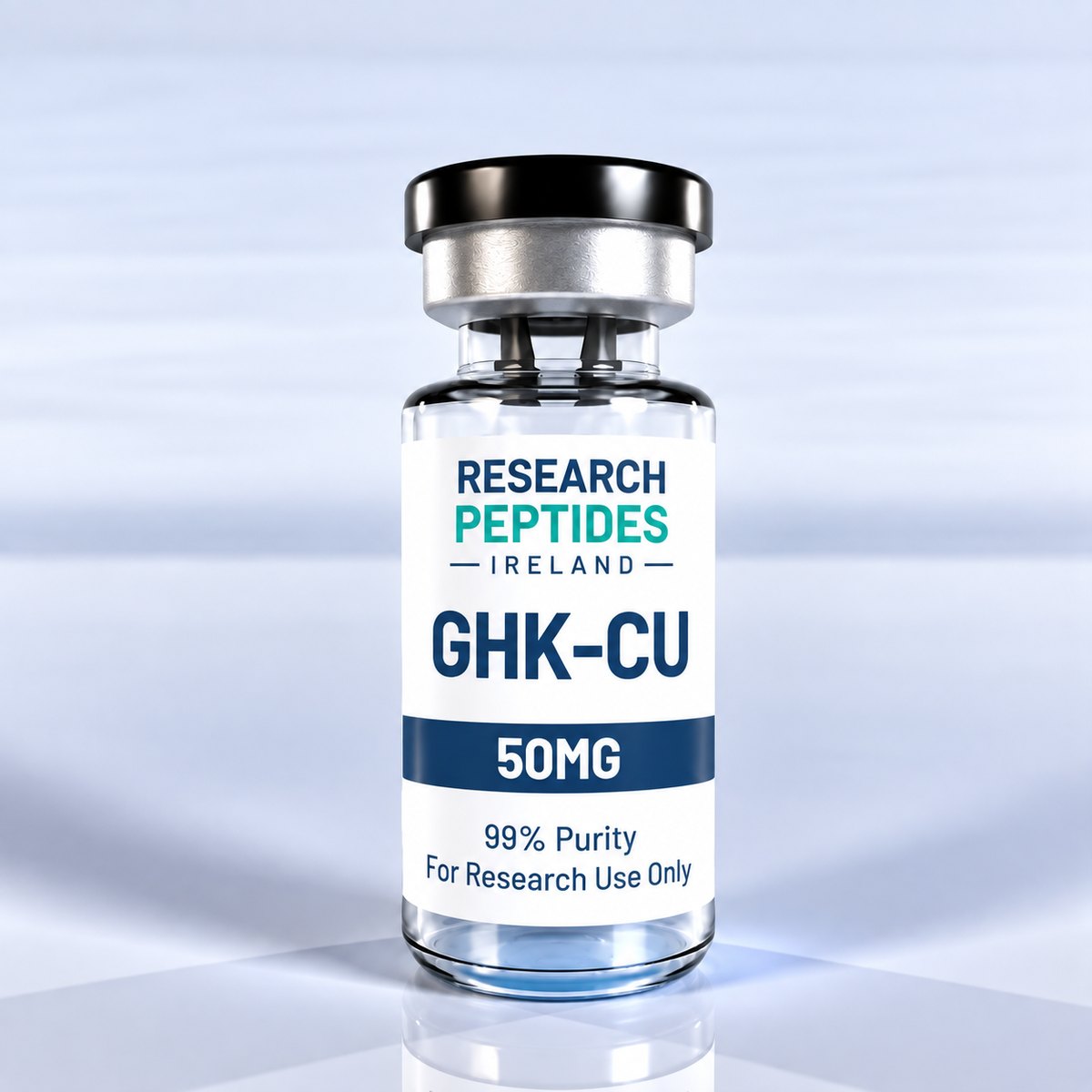
Buy GHK-Cu 50mg in Ireland for laboratory and scientific research. GHK-Cu, also known as copper tripeptide-1, copper peptide GHK-Cu, or prezatide copper, is a copper(II) complex of the naturally occurring tripeptide glycyl-L-histidyl-L-lysine (Gly-His-Lys). GHK-Cu has been studied extensively in peptide chemistry, copper-binding research, cellular biology, tissue-remodelling research and molecular signalling. The commonly referenced 1:1 copper-GHK complex has a molecular formula of C14H22CuN6O4 and a molecular weight of approximately 401.91 g/mol.
What Is GHK-Cu?
GHK-Cu is a copper-binding tripeptide complex consisting of the three-amino-acid peptide GHK coordinated with copper(II).
GHK stands for:
Gly-His-Lys
or:
Glycine – Histidine – Lysine
The GHK peptide naturally occurs in human biological fluids and has a strong affinity for copper ions. When GHK binds copper(II), it forms the compound commonly known as GHK-Cu. Scientific research has examined the structure and copper-binding behaviour of this complex using techniques including spectroscopy, crystallography and other analytical methods.
GHK-Cu is therefore different from the copper-free GHK tripeptide. The presence of copper is an important part of the molecular identity of the complex.
GHK-Cu 50mg Product Specifications
| Specification | Details |
|---|---|
| Product | GHK-Cu |
| Common name | Copper tripeptide |
| Alternative name | Copper tripeptide-1 |
| Other name | Prezatide copper |
| Quantity | 50mg |
| Peptide | Gly-His-Lys |
| Peptide length | 3 amino acids |
| Metal | Copper(II) |
| Complex | 1:1 GHK:Cu complex |
| Molecular formula | C14H22CuN6O4 |
| Molecular weight | Approximately 401.91 g/mol |
| Product type | Research peptide / metallopeptide |
| Intended use | Laboratory research only |
The molecular data above refer to the commonly described 1:1 GHK-Cu complex, rather than copper-free GHK, which has a molecular weight of approximately 340.38 g/mol.
GHK-Cu Peptide Structure
GHK-Cu is based on the short peptide sequence:
Gly-His-Lys
The three amino acids are:
- Glycine
- Histidine
- Lysine
Copper(II) coordinates with donor atoms associated with the peptide, including nitrogen atoms from the peptide backbone and the histidine imidazole group. Structural research has used techniques such as X-ray crystallography, EPR spectroscopy, X-ray absorption spectroscopy and NMR to investigate the copper-GHK complex.
This combination of a short peptide and a transition-metal ion makes GHK-Cu particularly interesting for metallopeptide and coordination-chemistry research.
GHK-Cu vs GHK
GHK and GHK-Cu should not be treated as identical compounds.
| Feature | GHK | GHK-Cu |
|---|---|---|
| Full name | Glycyl-L-histidyl-L-lysine | Copper complex of GHK |
| Sequence | Gly-His-Lys | Gly-His-Lys coordinated with Cu(II) |
| Copper | No | Yes |
| Peptide length | 3 amino acids | 3 amino acids + Cu(II) |
| Molecular weight | ~340.38 g/mol | ~401.91 g/mol for the neutral 1:1 complex |
| Research class | Tripeptide | Copper-binding metallopeptide |
The distinction is important when selecting research materials, interpreting analytical data and comparing molecular weights. PubChem separately identifies the copper-free GHK peptide and copper-containing GHK species.
GHK-Cu 50mg for Laboratory Research
The 50mg GHK-Cu format provides a defined quantity of copper tripeptide for laboratory research.
GHK-Cu has been investigated in several areas of experimental science, including:
- Copper-binding research
- Metallopeptide chemistry
- Peptide structure
- Molecular signalling
- Cellular biology
- Gene-expression research
- Oxidative-stress research
- Tissue-remodelling models
- Protein and peptide interactions
- Analytical chemistry
Published research has examined GHK and GHK-Cu in cellular and biological models, including studies of gene expression and molecular pathways.
GHK-Cu and Copper-Binding Research
One of the defining properties of GHK is its strong ability to bind copper(II).
The histidine residue is particularly important to the coordination chemistry of the complex. Research has characterized the interaction between GHK and Cu(II) using multiple analytical approaches.
This makes GHK-Cu useful as a research material for investigating:
Copper coordination
Researchers can examine how copper ions interact with short peptide sequences.
Metallopeptide chemistry
GHK-Cu provides a defined example of a biologically relevant copper-binding peptide complex.
Molecular structure
Researchers can study the relationship between peptide structure and metal coordination.
Analytical chemistry
The compound can be characterized using appropriate chromatographic and spectroscopic techniques.
GHK-Cu and Cellular Research
GHK-Cu has attracted considerable scientific interest because GHK is a naturally occurring peptide and copper-binding molecule.
Research has investigated GHK and GHK-Cu in relation to cellular processes including:
- Gene expression
- Cellular signalling
- Oxidative stress
- Inflammatory pathways
- Cell growth
- Tissue-remodelling biology
- Extracellular matrix research
Published reviews describe GHK-Cu as an area of ongoing preclinical research and discuss experimental findings involving cellular and animal models.
These findings represent research areas rather than established clinical applications.
GHK-Cu and Gene Expression Research
GHK has been investigated for its effects on gene-expression patterns in experimental models.
Research has examined whether GHK can influence the expression of genes associated with cellular processes such as:
- Extracellular matrix regulation
- Cellular stress
- Inflammatory signalling
- Tissue biology
- Oxidative responses
- Cellular repair pathways
Researchers studying these mechanisms can use GHK-Cu as a defined copper-containing research material.
GHK-Cu and Oxidative Stress Research
Another area of scientific interest is the relationship between GHK-Cu and oxidative-stress pathways.
Copper is an essential trace element involved in numerous biological processes, while GHK provides a peptide-based copper-binding environment.
Laboratory research can therefore investigate GHK-Cu in controlled experimental models involving:
- Reactive oxygen species
- Oxidative stress
- Antioxidant-related pathways
- Cellular stress responses
- Copper metabolism
- Peptide-metal interactions
GHK-Cu 50mg Research Format
The 50mg format provides researchers with a larger quantity of GHK-Cu for laboratory applications.
A defined 50mg quantity can be useful for research programmes involving:
- Analytical characterization
- Peptide chemistry
- Copper-binding studies
- Cellular experiments
- Comparative research
- Multiple laboratory assays
- Molecular biology research
The product contains GHK-Cu rather than copper-free GHK.
Quality Testing and COA
Quality documentation is an important part of selecting research peptides and metallopeptides.
Available product documentation may include:
- Product identification
- Batch or lot number
- Quantity
- Purity
- HPLC analysis
- Mass spectrometry
- Copper content or composition information
- Testing date
- Product specifications
HPLC
High-performance liquid chromatography can be used to evaluate chromatographic purity and identify components within a research material.
Mass Spectrometry
Mass spectrometry can help researchers characterize molecular mass and support compound identification.
For a copper-containing peptide complex, analytical information can be particularly useful because the measured molecular characteristics depend on the specific molecular form and composition being examined.
GHK-Cu Molecular Weight
The molecular weight commonly cited for the 1:1 GHK-Cu complex is approximately 401.91 g/mol.
The copper-free GHK tripeptide has a molecular weight of approximately 340.38 g/mol. The difference reflects the incorporation of copper into the complex.
Researchers should therefore avoid using the molecular weight of copper-free GHK when working with a copper-containing GHK-Cu material.
GHK-Cu CAS Number
CAS 89030-95-5 is commonly associated with prezatide copper, also known as GHK-Cu or copper tripeptide-1. Current chemical databases and research references associate this identifier with the copper-containing compound.
The copper-free GHK peptide has a different identifier, which further demonstrates why GHK and GHK-Cu should be treated as separate research materials.
Storage and Handling
GHK-Cu should be stored and handled according to the product documentation and established laboratory procedures.
Researchers should consider:
- Appropriate temperature conditions
- Protection from moisture
- Protection from direct light
- Keeping the container properly sealed
- Minimizing unnecessary environmental exposure
- Following appropriate laboratory safety procedures
Specific storage requirements should follow the documentation supplied with the product.
Why Buy GHK-Cu 50mg in Ireland?
Buying GHK-Cu 50mg in Ireland provides researchers with access to a defined copper-binding tripeptide format for laboratory research.
Research Peptides Ireland provides product information covering:
- GHK-Cu identity
- Gly-His-Lys structure
- Copper complex characteristics
- Molecular specifications
- Research applications
- Quality information
- Analytical testing
- Storage information
The 50mg format provides a clearly defined quantity for research applications.
GHK-Cu Ireland Delivery
GHK-Cu 50mg is available for customers in Ireland, subject to applicable laws and regulations.
Worldwide delivery may also be available where permitted by the destination country’s regulations concerning research peptides and laboratory materials.
Customers should ensure that research materials are permitted for their intended laboratory use and destination.
Buy GHK-Cu 50mg Ireland
If you are looking to buy GHK-Cu 50mg in Ireland, Research Peptides Ireland provides this copper-binding tripeptide in a defined 50mg research format.
GHK-Cu is the copper(II) complex of glycyl-L-histidyl-L-lysine (Gly-His-Lys) and has been studied in peptide chemistry, copper coordination, cellular biology and molecular research.
Researchers can review the product specifications, molecular characteristics and available quality documentation before ordering.
GHK-Cu 50mg — research-grade copper tripeptide for laboratory research.
Research Use Only
GHK-Cu 50mg is supplied strictly for laboratory and scientific research.
It is not marketed as a medicine, dietary supplement or consumer health product.
This product page does not provide instructions for human administration, dosing or treatment.
Frequently Asked Questions
What is GHK-Cu?
GHK-Cu is a copper(II) complex of the tripeptide glycyl-L-histidyl-L-lysine (Gly-His-Lys). It is also known as copper tripeptide-1 and prezatide copper.
What does GHK stand for?
GHK represents the three amino acids glycine, histidine and lysine.
What is the sequence of GHK?
The GHK tripeptide sequence is Gly-His-Lys.
What is the molecular weight of GHK-Cu 50mg?
The commonly described 1:1 GHK-Cu complex has a molecular weight of approximately 401.91 g/mol.
What is the molecular weight of GHK?
Copper-free GHK has a molecular weight of approximately 340.38 g/mol.
What is the difference between GHK and GHK-Cu 50mg?
GHK is the copper-free tripeptide Gly-His-Lys. GHK-Cu is the copper(II) complex formed when GHK coordinates with copper.
What is GHK-Cu studied for?
GHK-Cu has been studied in copper-binding chemistry, cellular biology, gene-expression research, oxidative-stress research and tissue-remodelling models.
What size of GHK-Cu is available?
This product is available in a 50mg research format.
What is the CAS number for GHK-Cu 50mg?
CAS 89030-95-5 is commonly associated with prezatide copper/GHK-Cu.
Is GHK-Cu a peptide?
GHK-Cu is a copper-binding metallopeptide complex based on the three-amino-acid GHK peptide.
Is GHK-Cu the same as copper tripeptide-1?
Copper tripeptide-1 is a commonly used name for the GHK-Cu copper complex.
Is GHK-Cu available in Ireland?
Yes. GHK-Cu 50mg is available for laboratory research in Ireland, subject to applicable regulations.
Does GHK-Cu come with quality documentation?
Available product documentation may include batch information, purity testing and analytical characterization such as HPLC and mass spectrometry.
Is GHK-Cu for human use?
No. This product is supplied strictly for laboratory research use and is not intended for human use or self-administration.





There are no reviews yet.