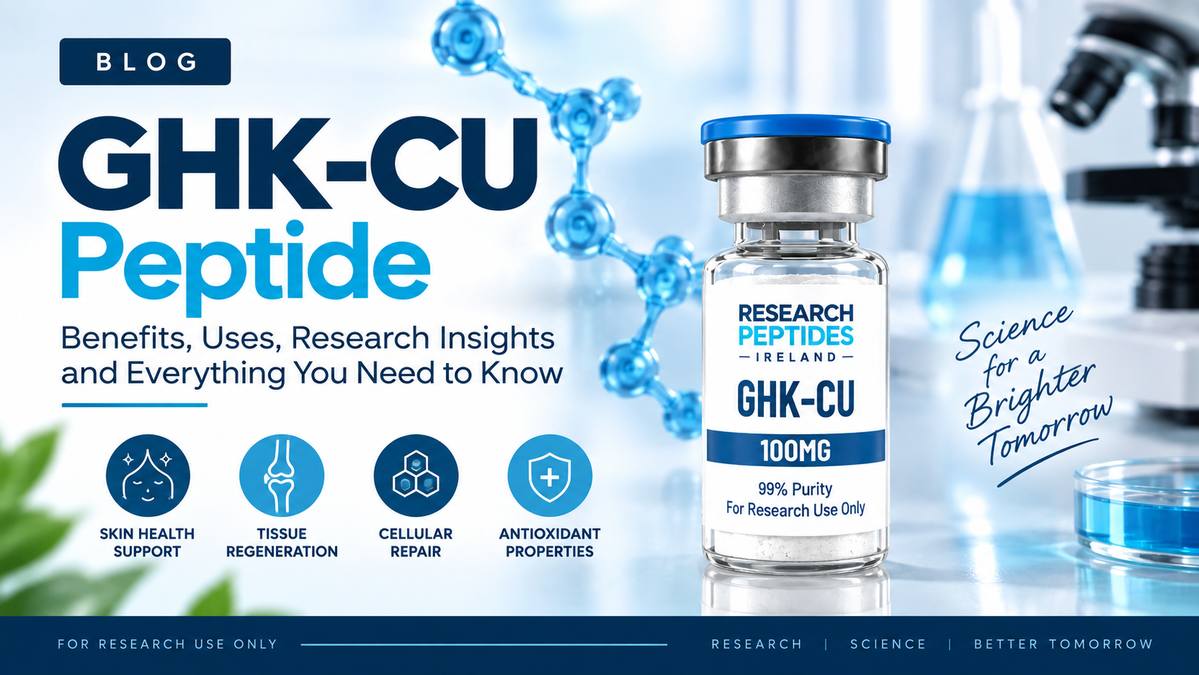
If you are researching the GHK-Cu peptide, you need accurate information on its laboratory applications, verified pricing, and strict handling protocols to ensure reproducible results. This guide details the documented in vitro benefits of Copper Tripeptide-1, provides transparent pricing for 50mg (€39.99) and 100mg (€69.99) research vials, and explains proper reconstitution and storage methods. We supply strictly Research Use Only (RUO) GHK-Cu with batch-specific Certificates of Analysis (COAs), third-party HPLC/MS testing, and discreet tracked shipping from Ireland—never for human cosmetic or therapeutic application.
Documented In Vitro Benefits of GHK-Cu in Laboratory Studies
GHK-Cu is not a “skincare ingredient” in research contexts; it is a mechanistic tool for investigating how endogenous peptides regulate tissue homeostasis at the cellular level. First identified in human plasma in 1973, this tripeptide binds copper ions with high affinity and modulates gene expression related to extracellular matrix remodeling, antioxidant defense, and age-related decline. Peer-reviewed in vitro studies consistently demonstrate three primary research applications:
- Extracellular Matrix Remodeling: GHK-Cu upregulates collagen I/III, elastin, glycosaminoglycans, and metalloproteinase inhibitors (TIMPs) while downregulating pro-inflammatory cytokines like TNF-α and IL-6 in primary human dermal fibroblasts and 3D skin equivalents. Researchers use it to dissect signaling pathways involved in fibrosis and photoaging—not to formulate topical products.
- Cellular Senescence Modeling: Studies show GHK-Cu influences p16/p21 expression, SA-β-gal activity, and mitochondrial function in aged vs. young cell lines, providing insights into reversible aging phenotypes. It serves as a reference compound for identifying senolytic or senomorphic interventions in biogerontology.
- Angiogenesis & Wound Healing Assays: GHK-Cu stimulates VEGF secretion, endothelial tube formation, and re-epithelialization rates in scratch-wound or co-culture models where copper-dependent enzymes (e.g., lysyl oxidase) are critical. It helps map the role of trace metals in tissue repair without systemic confounders.
⚠️ Critical Compliance Note: These benefits describe laboratory observations only. GHK-Cu is not approved for human use outside licensed medicinal products. Any website suggesting topical or injectable application violates Irish HPRA regulations and compromises scientific integrity. Our role is solely to support legitimate inquiry into copper-peptide biology.
Transparent Research Pricing: 50mg vs. 100mg Vials
We provide clear, EUR-denominated pricing with no hidden fees or currency conversion surprises. All prices include batch-specific COA access and tracked Irish dispatch:
| Vial Size | Price (EUR) | Best For | Key Advantage |
|---|---|---|---|
| 50mg | €39.99 | Pilot studies, dose-response curves, small-scale fibroblast assays | Lower upfront cost; ideal for optimizing concentrations before scaling |
| 100mg | €69.99 | Longitudinal senescence studies, multi-arm ECM remodeling projects | Reduces reconstitution frequency; ensures single-batch consistency across months-long experiments |
Cost Efficiency Note: The 100mg vial offers ~13% savings per mg compared to 50mg, but only choose it if your protocol justifies sustained use. Reconstituted GHK-Cu has limited stability (≤14 days refrigerated). Unused reconstituted peptide cannot be reliably refrozen—aliquot immediately post-
Understanding GHK-Cu Peptide Quality Control: Beyond Purity Claims
Not all “GHK-Cu” is biochemically equivalent. Rigorous verification requires three layers of validation:
1. Stoichiometric Copper Confirmation
Purity % alone is meaningless without verifying copper-to-peptide ratio. True GHK-Cu contains exactly 1 Cu²⁺ ion per tripeptide molecule. We use ICP-MS (Inductively Coupled Plasma Mass Spectrometry) alongside HPLC to confirm 1:1 stoichiometry. Batches with excess free copper or deficient binding fail release—free copper causes cytotoxicity in cell assays, skewing results.
2. Sequence & Modification Verification
LC-MS/MS must confirm:
- Exact mass of [Gly-His-Lys + Cu] complex
- Absence of acetylated/amidated variants (unless specified)
- No oxidation at histidine residue (common degradation product)
3. Endotoxin & Sterility for Cell Culture
Primary fibroblasts and keratinocytes are exquisitely sensitive. All batches undergo LAL testing (<0.1 EU/mg) and sterility screening. Never assume “research grade” implies cellular compatibility—this is non-negotiable for publishable work.
Proper Handling Protocols to Preserve Bioactivity
GHK-Cu’s copper center demands meticulous care:
- Storage: Lyophilized vials at -20°C in darkness with desiccant. Avoid frost-free freezers (defrost cycles cause moisture ingress).
- Reconstitution: Use sterile bacteriostatic water in laminar flow hood. Add diluent slowly down vial wall; swirl gently—never vortex (shear forces disrupt Cu coordination). Final concentration typically 1–10 mM depending on assay.
- Post-Reconstitution: Aliquot into single-use volumes; store at -80°C. Refrigerated solutions degrade within days due to copper redox cycling. Always include vehicle controls (bacteriostatic water alone) to distinguish peptide effects from solvent artifacts.
- Light Sensitivity: Perform all handling under dimmed/red light. Amber vials protect during storage but offer no protection during open-vial manipulation.
Frequently Asked Questions (FAQs)
Can GHK-Cu be used in primary human cell cultures safely?
Yes, only when endotoxin-tested and handled aseptically. Primary dermal fibroblasts require <0.1 EU/mg endotoxin levels; always verify this on the COA before seeding. Reconstitute in sterile technique, filter-sterilize (0.22 µm) if required, and include vehicle controls. Never apply topically or inject—this violates RUO status and invalidates research ethics. Validate bioactivity in your specific cell line first using established positive controls (e.g., TGF-β stimulation for collagen).
How does GHK-Cu differ from other copper peptides like CBP or Cu-GHK?
GHK-Cu specifically refers to the natural human sequence Gly-His-Lys bound to Cu²⁺. “CBP” (Copper Binding Peptide) is often a marketing term for synthetic analogues with modified sequences (e.g., acetylated N-terminus) that alter receptor binding and stability. CBP may show different kinetics in assays. Always confirm exact amino acid sequence and modifications via MS—do not assume interchangeability. Our GHK-Cu matches the native human structure verified by reference standards.
What storage conditions prevent GHK-Cu degradation long-term?
Lyophilized GHK-Cu must be stored at -20°C or colder in complete darkness with desiccant. Moisture and light are primary degradation drivers. Once reconstituted, aliquot immediately and store at -80°C; repeated freeze-thaw cycles cause irreversible copper dissociation. Refrigerated solutions remain viable ≤14 days—but validate stability in your assay system first. Document storage conditions meticulously; reproducibility demands traceability.
Are there legal restrictions on possessing GHK-Cu for research in Ireland?
Possession for legitimate laboratory research is legal provided it is explicitly RUO and not intended for human use. GHK-Cu is unlicensed but not controlled under Misuse of Drugs Acts. Importing without proper documentation may trigger customs scrutiny. Always declare as “laboratory research chemical – RUO” with COAs and institutional proof. Maintain records of research purpose (ethics approval, lab notebooks). Consult your biosafety officer for site-specific requirements.
What should I do if my GHK-Cu vial appears discolored or clumped?
Discoloration (green/brown tint) indicates copper oxidation; clumping signals moisture ingress—do not use. Photograph vial with batch ID visible and contact us immediately with order number. We replace within 48 hours and investigate root causes. Compromised GHK-Cu yields false negatives in collagen assays due to inactive copper species. Prevent issues by verifying packaging integrity upon delivery and storing correctly. Your data depends on uncompromised materials—we stand behind every vial.